
Cable Ducting Installation in Cobham
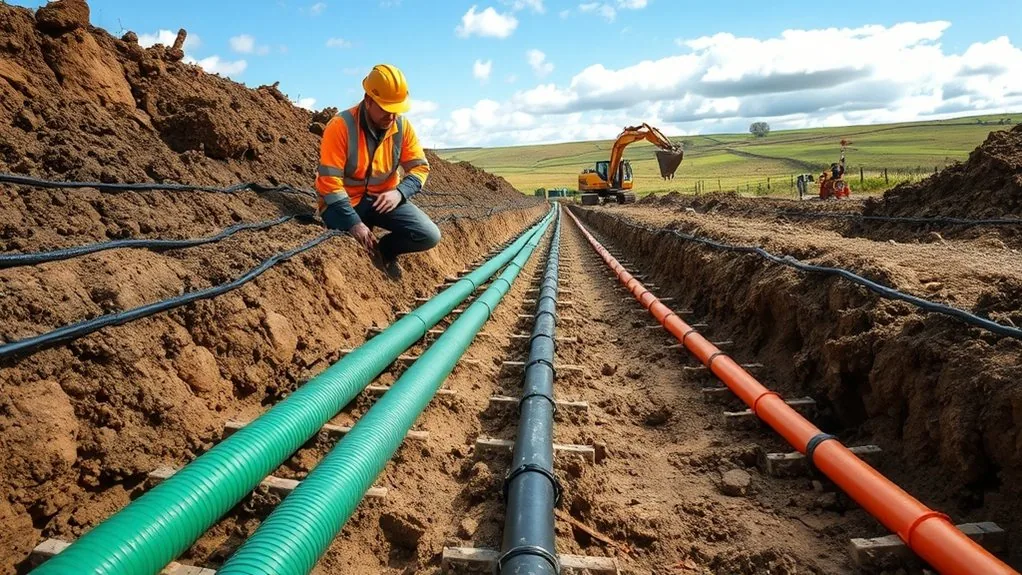
If you need reliable cable ducting installation in Cobham to protect underground power, data, and telecom cables, it is essential to use properly designed and installed ducts.
These ducts ensure cables are shielded from damage and allow for future upgrades without excavation.
They also meet BS 7671, NJUG, DNO, and local authority standards.
Contact us for a fast quote or emergency callout in Cobham.
Although the term sounds straightforward, cable ducting installation is a defined process of routing and protecting electrical, data, or utility cables within purpose-designed conduits that comply with relevant UK and Cobham-specific regulations. You’re not just burying pipes; you’re implementing a controlled cable management strategy that safeguards services from mechanical damage, moisture, and interference.
You select conduit systems and duct types according to voltage, signal class, load profiles, and ground conditions, then set depth, separation, and marking in line with BS 7671, NJUG guidance, and local authority standards. You also allow for future capacity, accessible draw pits, and accurate as-built records. Done correctly, cable ducting installation creates a safe, maintainable underground infrastructure that minimises risk, disruption, and regulatory non-compliance.
When you’re planning new or upgraded services in Cobham—whether that’s LV/HV power, fibre, EV chargers, or CCTV—cable ducting installation becomes essential wherever cables need physical protection, controlled routing, or regulatory compliance below ground or within structures. You’ll typically need it whenever exposed cabling would compromise cable safety, long‑term reliability, or legal duties under BS 7671, the NRSWA, or utility-adoption standards.
You should specify ducting when you:
In these cases, ducting isn’t optional; it’s the compliant, auditable solution.
When you commission cable ducting installation in Cobham, the process starts with a detailed site assessment to identify existing services, ground conditions, and any constraints under local authority and utility regulations. From there, controlled trenching and groundworks are carried out, followed by accurate duct laying and routing to specified depths, separations, and bend radii. Finally, the system’s integrity is checked through pressure testing, mandrelling, and visual inspection before sign‑off and reinstatement.
Before any trench is opened or duct is laid, a structured site assessment establishes whether the installation can proceed safely, legally, and efficiently. You’ll begin by reviewing site plans, access routes, and any constraints near buildings, highways, or existing infrastructure, ensuring compliance with Cobham-specific and national regulations.
You’ll then commission utility mapping to identify and verify the position of buried services, using records, on-site scanning, and CAT & Genny techniques. This reduces strike risk and informs safe working zones and separation distances.
Soil testing follows, confirming ground composition, bearing capacity, and drainage characteristics. These results guide duct selection, cover depth, and bedding specifications, while highlighting contamination or instability risks. Throughout, you’ll document findings for method statements, risk assessments, and permit applications.
With the site assessed and underground services mapped, trenching and groundworks can proceed in a controlled, compliant manner. You’ll define trench lines, depths, and widths according to cable types, loading, and soil conditions, always aligning with UK safety regulations and HSG47 guidance. Mechanical excavation is tightly managed, with hand-digging near existing utilities and continuous monitoring for ground instability.
You’ll then trim trench bottoms, manage groundwater, and stockpile spoil safely, preventing collapse and contamination. Barriers, signage, and safe access routes protect operatives and the public throughout.
| Stage | Key Actions | Compliance Focus |
|---|---|---|
| Setting Out | Mark routes, depths | Design specs, permits |
| Service Verification | Confirm utility positions | Utility plans, HSG47 |
| Excavation | Machine dig, hand-dig near services | Safety regulations, PPE |
| Trench Preparation | Level base, control water | Stability, drainage |
| Spoil Management | Store, segregate, reuse/dispose | Environmental regulations |
Although the trenches are now prepared, duct laying only proceeds once you’ve confirmed levels, separation distances, and route alignment against the approved design and utility plans. You’ll position the conduit systems on a compacted granular bed, maintaining regulated cover depths and clearances from gas, water, and telecom assets.
You secure ducts in straight lines with smooth radius bends, avoiding sharp deflections that could damage cables or disrupt cable management. Where multiple ducts run in parallel, you’ll use spacers to maintain separation and a consistent formation, ready for identification and future access.
Backfill is placed in controlled layers around the ducts, ensuring full side support without distortion. Throughout, you’ll keep ducts capped or sealed to prevent debris or water ingress during construction.
Once the ducts are laid, aligned, and backfilled, the installation moves into a verification stage where you prove the system’s integrity and compliance with the project specification and UK standards. You’ll start by mandrel and CCTV testing to confirm bore continuity, correct gradients, and absence of deformation or obstructions.
Next, you pressure‑test or air‑test as required to check joint integrity and prevent water ingress that could compromise cable management and long‑term performance. You’ll also verify duct markers, depth, and separation distances to maintain underground safety and coordination with other utilities.
Finally, you document as‑built drawings, test certificates, and photographic evidence. This record demonstrates regulatory compliance and gives you a verifiable baseline before any cables are pulled or commissioned.
When you’re planning underground cable routes in Cobham, choosing between cable ducting installation and traditional open-cut excavation has direct implications for compliance, safety, and lifecycle performance. You’re not just digging a trench; you’re making long-term decisions about cable management, risk exposure, and the resilience of your underground infrastructure.
| Aspect | Cable Ducting vs Traditional Excavation |
|---|---|
| Installation Method | Ducting uses pre-formed conduits; excavation exposes and beds each cable directly in soil. |
| Safety & Compliance | Ducting supports clearer separation, identification, and BS 7671-conforming routes. |
| Future Works | Ducts enable cable replacement or upgrade without repeat bulk excavation. |
With ducting, you’re designing a controlled corridor for utilities, reducing accidental damage, simplifying isolation, and supporting accurate as-built records demanded by local authorities and DNOs across Cobham.
By selecting cable ducting installation for your Cobham project, you’re not just routing power or data; you’re building a safer, more maintainable and regulation-ready asset. Properly specified ducts protect conductors from impact, moisture ingress and ground movement, markedly improving cable security and lifecycle performance.
Whether you’re upgrading a home supply or coordinating a multi-service commercial scheme, cable ducting in Cobham must be tailored to the load profile, occupancy type, and regulatory context of the site. In domestic settings, you’ll typically prioritise safe segregation of power, data, and telecoms, while allowing for EV chargers, garden power, and future Wireless power solutions. You must consider burial depths, marker tape, and compliant bends to protect cables from accidental strikes.
For commercial premises, the focus shifts to higher capacities, complex routing, and resilience. You’ll often need multi-compartment duct runs for LV, HV, control, and Fiber optics, designed to BS 7671, NJUG, and local authority requirements, with clear access points for maintenance, retrofitting, and system expansion.
Across Cobham, these design priorities are implemented through a structured cable ducting installation service that covers survey, specification, installation, and testing. You’ll start with a site survey that identifies existing utilities, ground conditions, and load requirements, ensuring compliant cable management and robust underground safety.
From there, duct sizes, materials, and depths are specified in line with current BS standards, local authority guidance, and utility provider requirements. Installation is planned to minimise disruption, with controlled excavations, correct bedding and backfill, and clearly marked routes for future access.
Once ducts are installed, they’re mandrel-tested, roped, and capped or sealed to prevent ingress. Detailed records, as-built drawings, and test outcomes are then issued, giving you traceable, regulation-ready infrastructure.
As a specialist cable ducting contractor operating throughout Cobham, we combine disciplined engineering, rigorous safety management, and up‑to‑date regulatory knowledge to deliver compliant, durable installations. You benefit from designs calculated to BS EN standards, DNO specifications, and local authority requirements, ensuring reliable asset protection and future network flexibility.
We prioritise underground safety from survey to reinstatement, using detailed utility scans, method statements, and risk assessments tailored to your site. Our teams are trained in confined spaces, NRSWA-compliant street works, and cable maintenance considerations, so ducts are positioned, bedded, and labelled for safe future access.
You also get robust documentation: as-built records, test results, and material traceability, supporting ongoing asset management, audit readiness, and straightforward future upgrades.
You’ll understandably want clear answers on how long cable ducting installation takes, how its costs compare with traditional trench excavation, and whether your specific location in Cobham is covered. We’ll set out realistic installation timeframes based on scope, ground conditions, and statutory approvals. You’ll also see how our methods can reduce reinstatement costs and how we define our Cobham service area in line with local authority and utility requirements.
Although every project is different, most cable ducting installations in Cobham take anywhere from a single day for short, straightforward runs to several days or weeks for complex, multi-route schemes. Timescales depend on ground conditions, existing services, required depths, cable types, and access constraints.
Before work starts, you’ll need surveys, utility searches, and method statements that comply with safety regulations and local authority requirements. On-site, time is allocated to setting out, trial holes, safe excavation, duct laying, backfilling, and reinstatement, all sequenced to minimise service clashes and downtime.
Weather, traffic management approvals, and inspection slots from building control or network operators can also extend the programme. A professional installer will give you a phased schedule and update it as conditions change.
In many Cobham projects, installing correctly specified cable ducting is more cost‑effective over the asset’s life than repeatedly digging open trenches for new or replacement cables. When you run a Cost comparison, you shouldn’t just look at the initial trenching price; you also need to factor in reinstatement, traffic management, and future access for maintenance or upgrades.
| Factor | Cable ducting vs digging |
|---|---|
| Initial works | Similar or slightly higher than basic trench digging |
| Whole‑life costs | Lower, as you re‑use ducts instead of repeat excavation alternatives |
| Compliance & safety | Easier to meet BS 7671, NJUG, and CDM obligations |
Ducting also reduces strike risk when adding circuits, minimises service disruption, and keeps your installation strategy aligned with modern utility‑coordination practices.
Wondering whether your Cobham project’s within our coverage area is natural, especially where safety‑critical cable ducting is involved. You’ll be pleased to know we cover the majority of Cobham, including urban, suburban, and rural locations, provided site access and ground conditions allow safe working and compliant installation.
We routinely operate across Maidstone, Medway, Canterbury, Ashford, Tunbridge Wells, Dartford, Gravesham, Sevenoaks, Swale, Thanet, and surrounding villages. Before confirming, we assess service records, traffic management requirements, and any special constraints affecting underground safety.
If you’re unsure, share your postcode, site plans, and load requirements. We’ll verify coverage, determine appropriate duct specifications, and plan future cable maintenance access in line with BS EN standards, local authority guidance, and utility‑mapping best practice.
Yes, we provide emergency call-outs for urgent cable ducting repairs in Cobham, subject to engineer availability and site safety. Our engineers respond quickly to carry out on-site diagnostics and temporary stabilisation. They plan permanent repairs following current BS7671, NRSWA, and utility guidance to ensure safety and compliance.
Yes, existing underground cables can usually be upgraded using current ducting routes. This depends on the condition and capacity of the ducts, which must be checked through a CCTV survey, pulling-tension calculations, and bend radius verification. It is important to ensure there is spare duct space, correct separation from other services, and compliance with BS 7671 and CDM regulations. If the ducts are damaged, waterlogged, or too small, replacement or installing parallel routes is recommended.
You usually need local highway authority consent and a Section 50 street works licence if you are digging in the highway. Planning approval is required if the work affects public land or sensitive areas. You must submit traffic management plans, utility searches, and method statements to comply with NRSWA and HSE regulations, coordinating with Cobham County Council and relevant district councils before starting any excavation or duct installation.
To locate and avoid other underground utilities before ducting work, you first obtain existing utility maps from asset owners and online sources. Next, you carry out a PAS 128-compliant survey using CAT & Genny equipment and ground-penetrating radar if necessary. All detected services are marked on-site and on drawings, and excavation safety controls such as exclusion zones, hand-digging near suspected services, and depth limits are designed. You must follow HSG47 guidance, comply with CDM duties, and notify relevant utility companies before starting intrusive work.
Yes, we coordinate fully with other contractors on multi-utility installation projects. This includes integrated planning of routes, shared trenches, and compatible ducting materials to optimise cable management and meet BS 7671, NJUG, and local authority requirements. Method statements, RAMS, permits, and work sequencing are aligned across trades to maintain safety and provide verifiable as-built records.
Once you’ve defined your route and load requirements, the next step is to request a precise, regulation-compliant quote for cable ducting installation in Cobham. You’ll want a breakdown covering survey, excavation, duct material selection, backfill, reinstatement, and testing, all aligned with BS EN and local authority standards.
Provide cable types, voltage, future expansion needs, soil conditions, and access constraints, so your quote reflects safe clearances, segregation, and long-term cable maintenance provisions.
| Quote Element | Why It Matters | What You Provide |
|---|---|---|
| Route & Depth | Ensures compliance, avoids clashes | Site plan, known services |
| Duct Specification | Matches load, environment, regulations | Cable ratings, ground conditions |
| Safety & Compliance | Minimises outage and hazard risk | Operational needs, maintenance access |
Request itemised costs and programme, plus method statements and RAMS.